Artists Statement
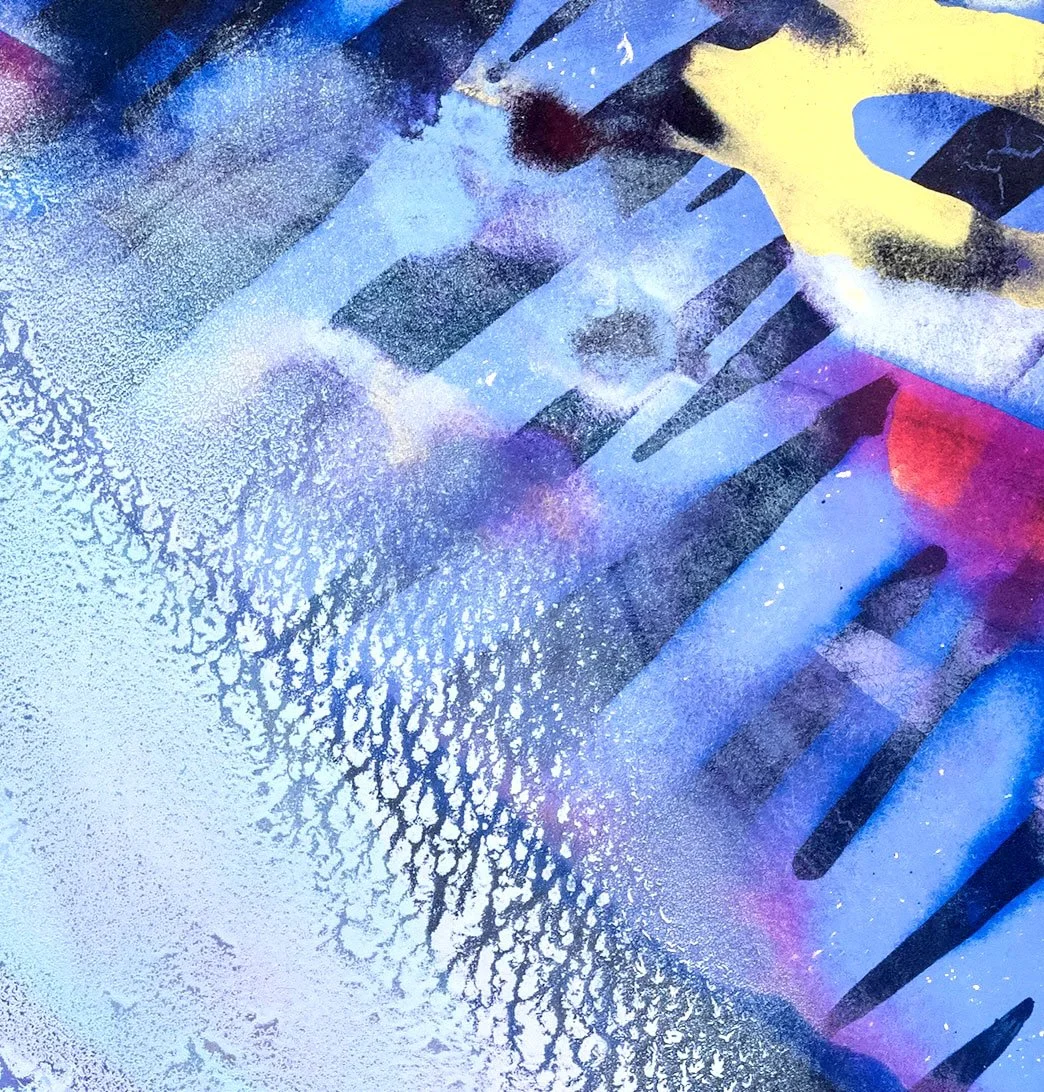
My paintings are built from poured pigment pulled across the surface of panel in long sweeps, then disrupted by sanding, compressing the surface while opening it inward — until what remains is something stratified and fluid, matte and luminous, the path the paint traveled mapped into the surface. From a distance they read as atmospheric color fields: electric blues dissolving into deep magenta, phosphorescent cyan burning against violet and near-black, with a recurring arc moving through the picture plane like a breaking wave or a gravitational pull. Up close, disrupted layers reveal themselves like windows into the painting’s history — time oscillating back and forth within the same plane. These paintings translate the climate crisis into hope — a reminder that the wonder is still there, and that we have the tools to protect it if we act.
The surface draws the viewer in — soft and matte, it reads like gouache but is acrylic, where scientific imaging connects to emotional interior, portal to map, data to feeling. The eye enters through color that backlights the paintings from within, beginning to move in a circular motion, pulled steadily inward toward the center, following the path the paint mapped. At the edges things slow down. Then the details arrive: moments of cartographic specificity, branching forms that recall neural pathways or the dendritic structures through which memory and sensation travel — places where one system bleeds into another. Wonder is the point of entry.
The titles work the same way — Bubblegum Ocean, Marshmallow Sea — a dark humor born from grief, an acknowledgment that we live in a world where synthetic material could become its own species, quietly and permanently remaking everything — including us. Once inside the work, something larger opens: the wonder of what lies beyond human reach — the unmapped seafloor, the vast dark of deep space.
My practice extends that tension into the conversation of Color Field painting — Frankenthaler, Louis, Olitski — but where they moved toward transcendence, the work moves inward: into the body, the psyche, the specific experience of living inside the climate crisis. The paintings speak to that: their color drawn from the sea itself — its living creatures, its bioluminescence, its scientific imaging — the sea not only subject but material, seawater carried into the surface alongside the pigment — surfaces built to hold loss. Sanding removes as extreme weather does, erasing while leaving its mark. Made by a woman and a mother who loves this planet and is not ready to let it go.
Making is how I stay inside all of it — the pouring, the sweeping, the sanding, the slow revelation of what the surface holds — in conversation with the natural world, with wonder, with what we stand to lose. The marks are embedded with hope. Making has always been how women hold the world together.