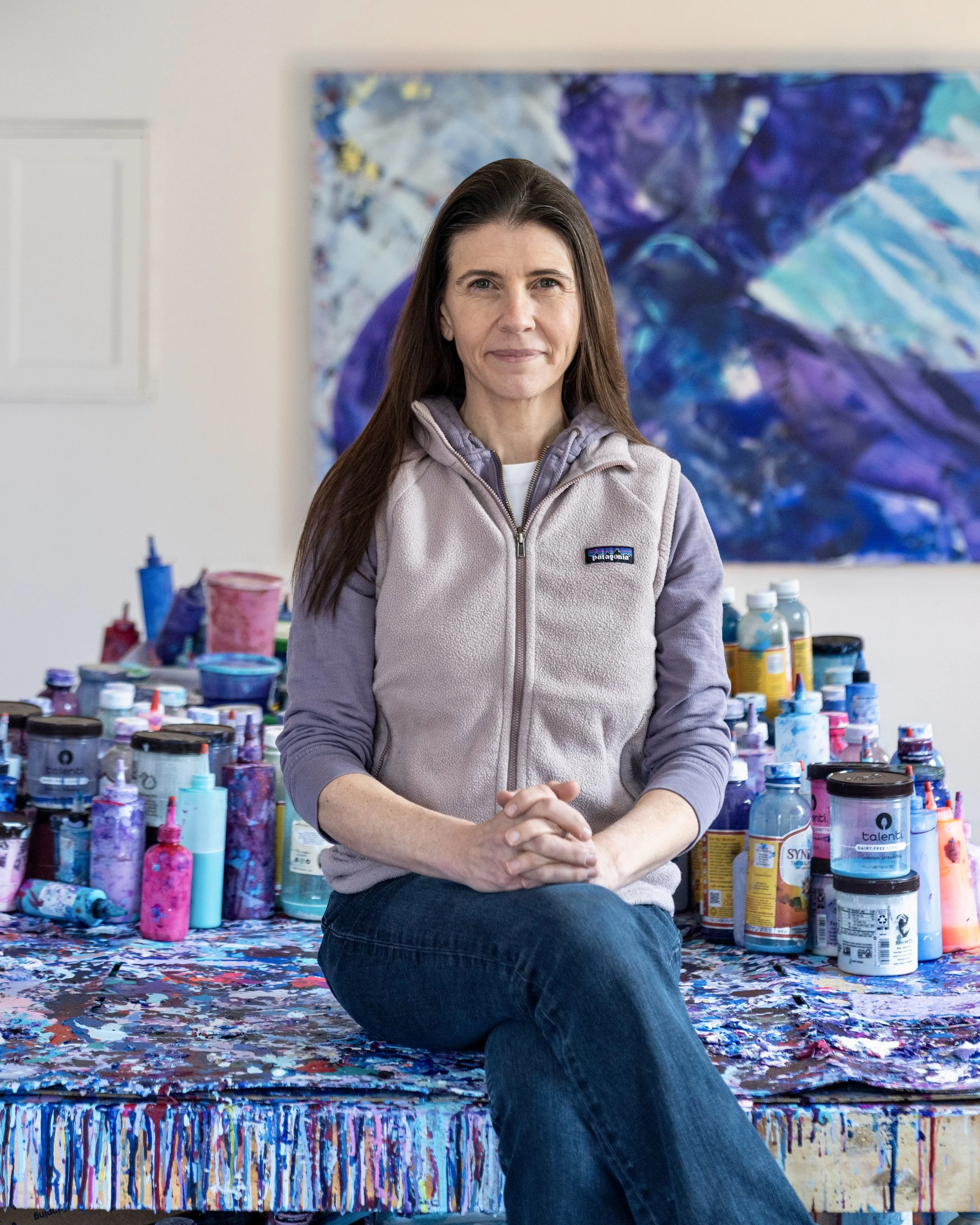
Bio

Julie Durkin Marty is a painter whose work maps the territory between the deep sea and outer space — not as landscapes, but as emotional states. Building layered surfaces of poured pigment moved with squeegees and brushes, then sanded back to a soft, skin-like finish that holds light from within, her paintings draw inspiration from seafloor topography, weather systems, and the visual language of scientific imaging. A recurring arc moves through the work like a breaking wave, a rainbow, a gravitational pull — the palette and the titles keep it from taking itself too seriously. Her paintings ask whether the cosmos and the unconscious operate according to the same deep structure — and whether that structure might, occasionally, have a sense of humor.

Working at the intersection of Abstract Expressionism, Color Field Painting, and Graffiti Art, her layered surfaces suggest portals, codes, and maps — gestural fields suspended between chaos and emergence. Her practice engages themes of climate anxiety, feminine agency, and hope embedded in the act of mark-making.

Born in 1977 in Pennsylvania, Durkin Marty received her BFA from Parsons School of Design and her MFA from Mason Gross School of the Arts at Rutgers University. Her work has been exhibited nationally in solo and group exhibitions at venues including DADA POST, Holland Tunnel, G-Town Arts, 63 Audubon, GBG Gallery, Mulry Fine Art, and CoLAB Arts, and has been featured in the New York Post, the Philadelphia Inquirer, the Palm Beach Daily News, the Hartford Art Pages, and Artist Magazine.

Artist Statement

Julie Durkin Marty

My paintings originate in a sustained, almost obsessive engagement with two of the most ungovernable terrains we know: the deep sea and outer space. Both lie beyond the threshold of direct experience — reached only through instruments, data visualizations, and the particular language of scientific imaging. Precisely this mediated quality captivates me — the fact that these places reach us only through their representations. My work lives in that gap between the measurable and the felt, between the diagram and the dream.

I build the works as deep, stratified fields — layer upon layer of poured pigment, each sanded back before the next application, until the surface arrives at a paradox: physically thin yet visually infinite, with a soft, velvety quality reminiscent of gouache or bloom-dusted skin. Formally, the works invoke the visual grammar of oceanographic sonar maps, satellite thermal imaging, and deep-field astronomical photography: tools designed to render the invisible legible. I appropriate this cartographic language not to document, but to interrogate what it means to map an interior life with the same rigor applied to the seafloor or the ionosphere. If science asks what is out there, my paintings ask what is in here — and whether the two questions are, finally, the same.

The process of making each work carries as much meaning as its imagery. I pour pigment directly onto the surface and move it — coaxed, dragged, directed — with squeegees and brushes. The squeegee pulls color across the plane in long, decisive sweeps, creating passages of compressed, atmospheric density; the brush finds the edges, the hesitations, the places where one system bleeds into another. Together these tools introduce a productive tension between the broad and the particular, the systemic and the intimate. Each layer gets sanded back — carefully, almost tenderly — before the process begins again. Sanding refuses erasure — it reveals the shapes that remain, forms that surface slowly, weaving through accumulated layers to conjure a space that feels like floating, suspended between water and sky, between sea and cosmos. Not every shape arrives with cosmic weight — some appear with a lightness and humor I follow without question, a reminder that improvisation and play matter as much as intention. The result: a surface of extraordinary softness, matte and glowing, as if the work is alive. This cycle of accumulation and removal drives the central argument of the work. Painting, for me, becomes an archaeology of the present tense.

At the heart of much of the work sits a recurring arc — a sweeping, vortex-like form that curves through the picture plane like a breaking wave, a rainbow, a gravitational field, or the rim of a celestial body caught mid-rotation. It emerges from the process, found through the sanding and the movement of pigment, a shape the work keeps returning to because it carries the right charge. At once intimate and vast, it holds containment and release in equal tension.

The resulting surfaces hold time as an unusual temporal quality — simultaneously ancient and immediate, as though the work has always existed and continues becoming. These paintings refuse stillness. They pulse and spin, charged with a centrifugal energy that pulls the eye inward and outward at once. The palette carries the same charge — electric blues, phosphorescent cyans, deep magenta, hot pink, smoldering crimson, and violet pushing against passages of cool white and violet gray. This range carries emotional weight. The warm hues carry urgency and heat; the cool ones, depth and distance. Together, they map a chromatic interior as expansive and contradictory as the terrains that inspire them. That sensation — suspension at the outer edge of the known — draws me precisely because it mirrors grief, longing, anticipation, and wonder. These states resist narrative but yield, partially, to color, gesture, and spatial depth.

Within each painting, forms emerge that suggest networks, pathways, and systems in flux. I often think of these configurations as visual cognates of neural cartography — the branching dendritic structures through which memory and sensation travel — or of the thermohaline circulation systems that drive oceanic currents across hemispheres, connecting distant bodies of water through invisible exchange. The paintings propose that emotional life operates according to the same branching, non-linear logic: nothing isolated, everything in motion, meaning arising through relationship rather than singularity.

The detection of water vapor clouds in deep interstellar space — enormous masses of water suspended in molecular clouds surrounding distant quasars, some holding more than one hundred trillion times the water in Earth's oceans — has increasingly shaped my thinking. The sheer scale of this fact destabilizes every assumption about where life's most essential element begins and ends. More than that, it offers a precise image for how emotion operates: elemental, pervasive, detectable only through indirect evidence, hovering at the edge of articulation in quantities impossible to fully reckon with. This discovery has deepened my commitment to surfaces that seem to hold light rather than merely reflect it, their sanded softness catching illumination the way fog holds the glow of a distant city.

Ultimately, these paintings reach toward a boundless cosmological intimacy. Celestial bodies drift like archipelagos through infinite dark. Seafloor ridges and nebular formations share the same formal vocabulary. Waves of shimmering starlight pass across those quiet, yielding surfaces, stirring luminous traces from beneath. The work asks whether the cosmos and the unconscious operate according to the same deep structure — and whether painting, at its most searching, might serve as the instrument precise enough to find out.

Julie Durkin Marty’s CV

917.902.4797

juliedurkinmarty@gmail.com

https://juliedurkinmarty.com/

Born 1977, Pennsylvania

Lives & Works in Redding, Connecticut

Education

2008 MFA, Mason Gross School of Arts, Rutgers University

2001 BFA, Parsons School of Design

Selected Solo Exhibitions

2025 Ocean In Space | Julie Durkin Marty, G-Town Arts, Georgetown, CT

              Line Loop | Julie Durkin Marty, 350 Bleecker, New York, NY

2024 Regional in Nature | Julie Durkin Marty, DADA POST USA, Norwich, CT

2010 Tick Tac | Julie Durkin Marty, Mulry Fine Art, West Palm Beach, FL

2007 Candy Box | Julie Durkin, Holland Tunnel, Brooklyn, NY

2006 Light Rhythm, EOH Gallery, Earlville, NY

Selected Group Exhibition

2026 Charged Field, G-Town Arts, Georgetown, CT

2025 Tiny Acts, G-Town Arts, Georgetown, CT

Origins Part II, Sixty-Three Audubon, Yale University, New Haven, CT

Summer Dreams, G-Town Arts, Georgetown, CT

Hot, Bailey Gallery, Hope Sound, FL

2024 Syncopation, G-Town Arts, Georgetown, CT
Abstract Visions, Martin Arts, Stuart, FL.

Summer Fun, G-Town Arts, Georgetown, CT

Luminosity, G-Town Arts, Georgetown, CT


2023 Mixed Bag, Big Bunny, Bethel, CT Summer Show, G-Town Arts, Georgetown, CT

2008 Paintings & Ceramics,  Mulry Fine Art, West Palm Beach, FL

2007 The Scavenger Hunter’s Cookbook, CoLAB Arts, New Brunswick, NJ
Blast, Holland Tunnel, Brooklyn, NY
New Year New Art, Mulry Fine Art, West Palm Beach, FL

2006 Durkin & Kiehart, Marquis Fine Art, Wilkes Barre, PA

2005 Abstracts, The Walt Meade Gallery at Roxbury Arts Group, Roxbury, NY

Selections, Apex Gallery, Asbury Park, NJ
Wet, The Walt Meade Gallery at Roxbury Arts Group, Roxbury, NY

Selections, Garrubbo Bazán Gallery, West Chester, PA

2004 Complex Collisions: Durkin & Marty, Locus Media Gallery, New York, NY
Selections, Garrubbo Bazán Gallery, West Chester, PA
Momenta 2004, White Columns, New York, NY

2003 Scent, The Proposition Gallery, New York, NY
Selections, Garrubbo Bazán Gallery, West Chester, PA
Momenta 2003, White Columns, New York, NY

Selected Awards

2007 Rutgers University Teaching Assistant Fellowship

1999 Parsons School of Design Scholarship

Selected Publications

2026 The Harford Art Pages

Artist Magazine

2025 The Woven Press

Redding Sentinel

2008 Mason Gross School of the Arts MFA Thesis (exhibition catalog)

2007 Palm Beach Daily News

The Palm Beach Post

Direct Art, volume 14

2006 The Citizens’ Voice

2005 The Philadelphia Inquirer

2002 The New York Post